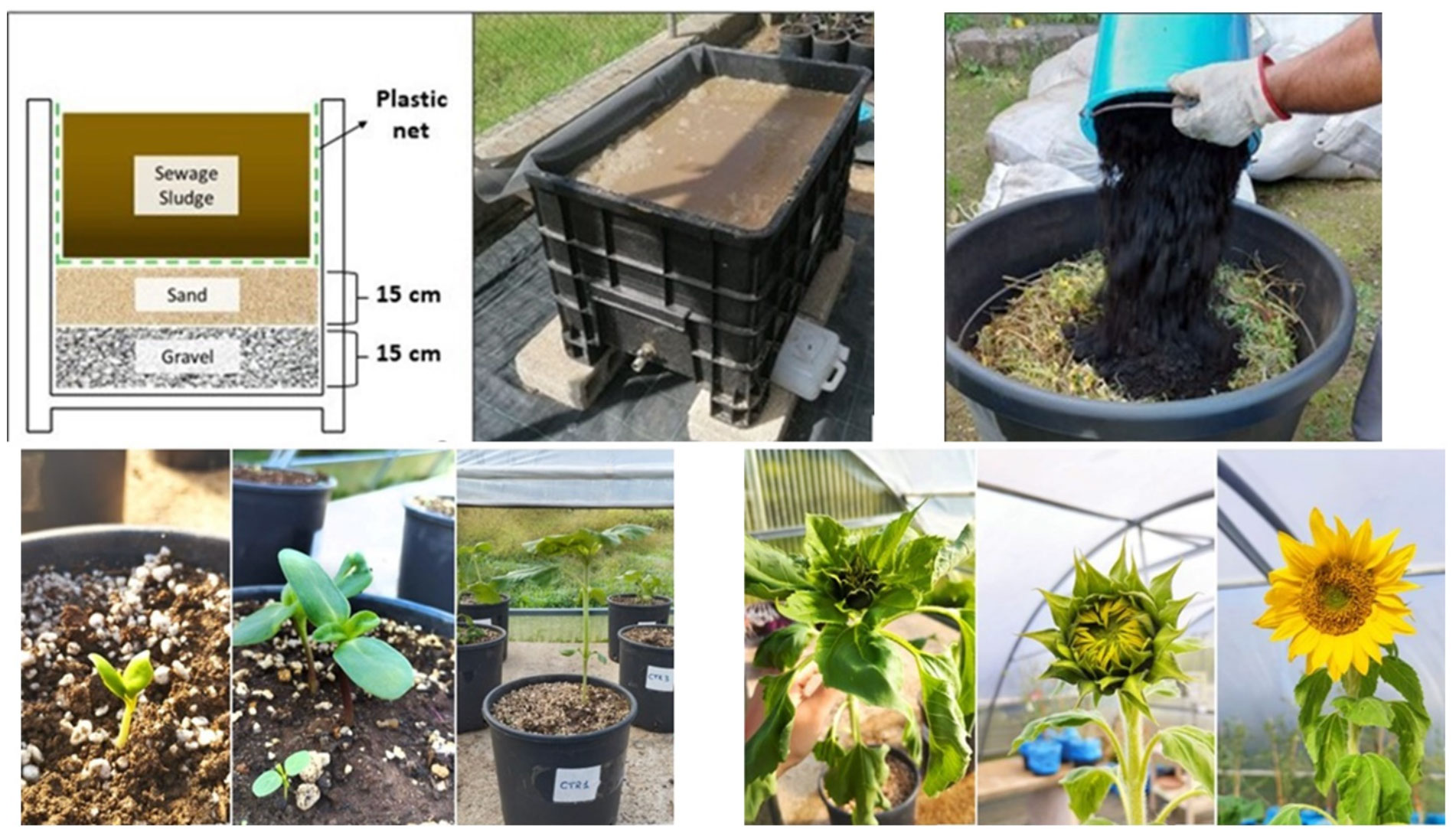
The Water Resource Recovery Facility’s (WWRF) Lab is the first worldwide circular-economy model applied to water, built within a university campus. The WRRF treats wastewater from the Palermo University campus, including departments, offices, and canteens, applying the circular economy concept: treat-recovery-reuse.
The main resources recovered from wastewater treatment are water for irrigation, nutrients, biopolymers and compost.
The UNIPA-WRRF stands as a leading model for applying the circular bio-economy paradigm to the water sector in Sicily and worldwide, using innovative membranes. Through experimental and mathematical modelling activities, the facility
aims to address climate change challenges and propose novel sustainable solutions for wastewater treatment processes, reducing its carbon footprint towards zero-emission neutrality.
The UNIPA-WRRF received two international recognitions from Water Reuse Europe in 2023 (finalist in innovation prize) and Water Europe in 2024 (first prize innovation award).
Description of the Water Resource Recovery Facility of Palermo University –
WRRF-UNIPA
Figure 1 shows the layout of the UNIPA WRRF with the main principal components:
Conceptual scheme of the WRRF – UNIPA.

The main goal of the WRRF – UNIPA is the recovery of the following resources
from wastewater treatment:
Construction works of the WRRF-UNIPA.
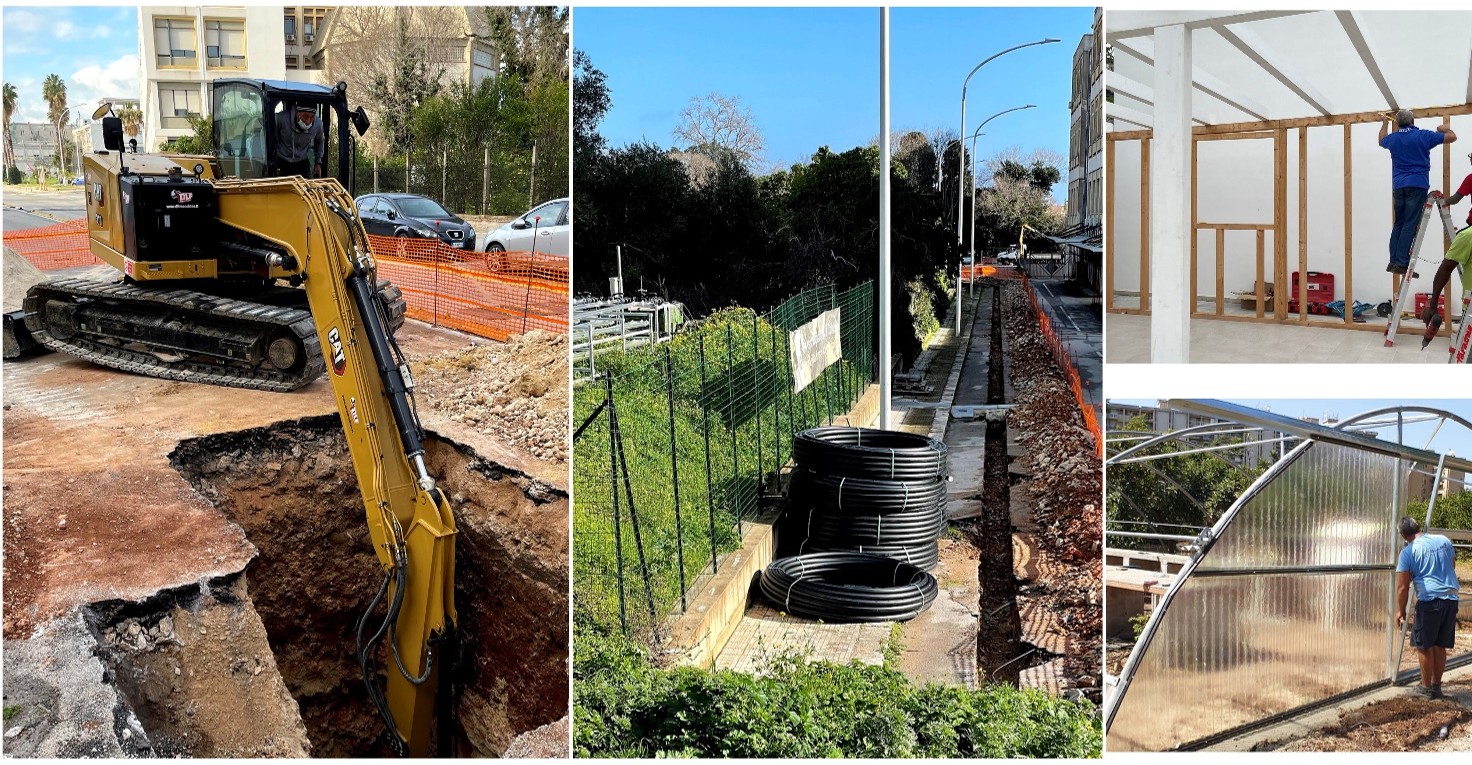

The innovative technologies of the WRRF – UNIPA
The WRRF-UNIPA adopts innovative technologies for the recovery of resources from the production of water suitable for reuse. The main water-smart solutions adopted are:
01: Sludge minimisation and production of water suitable for reuse
The wastewater produced within the campus is treated with an innovative and technologically advanced system. Through the application of the innovative Oxic Settling Anaerobic process, the production of sewage sludge to be disposed of is reduced. The use of polymeric or self-forming ultrafiltration membranes allows the
production of water with a quality suitable for agricultural reuse.
Technologies for sludge reduction and production of treated water.
Production of biopolymers (PHA)
The excess sewage sludge produced is used to train the microorganisms capable of producing PHA, which is subsequently extracted and used as a bioplastic precursor.
Technologies for biopolymer production.


Adsorption/Desorption columnse
Biochar and Zeolite are enriched with nitrogen and phosphorus using ionic adsorption-desorption columns. The enriched materials are then used as slow-release
fertilizers.
Technologies for fertilizers production.
Production of compost from sewage sludge (PHA)
The sludge produced is dried and used as compost for the growth of plants in the
greenhouse facility.